Even those living far from France – or perhaps even outside Europe – have heard of the Côte d’Azur. They know of the rich and famous, their yachts, and their escapades. It is a dream destination on the Mediterranean, brimming with esprit, charm, and that elusive je ne sais quoi.
But are you familiar with the Bay of Biscay on France’s west coast?
While the name may not tingle on the tongue like Champagne, the region rivals the southern coast in elegance – minus all the fanfare surrounding wealth and celebrity.
Take La Rochelle, for instance. This coastal city is so picturesque, it looks as though it were modeled after a picture postcard. You will find yachts here, certainly, but there are fishing boats, too. La Rochelle’s elegance is complemented by a distinct maritime flair that fills the air with the scent of salt and the endless horizon.
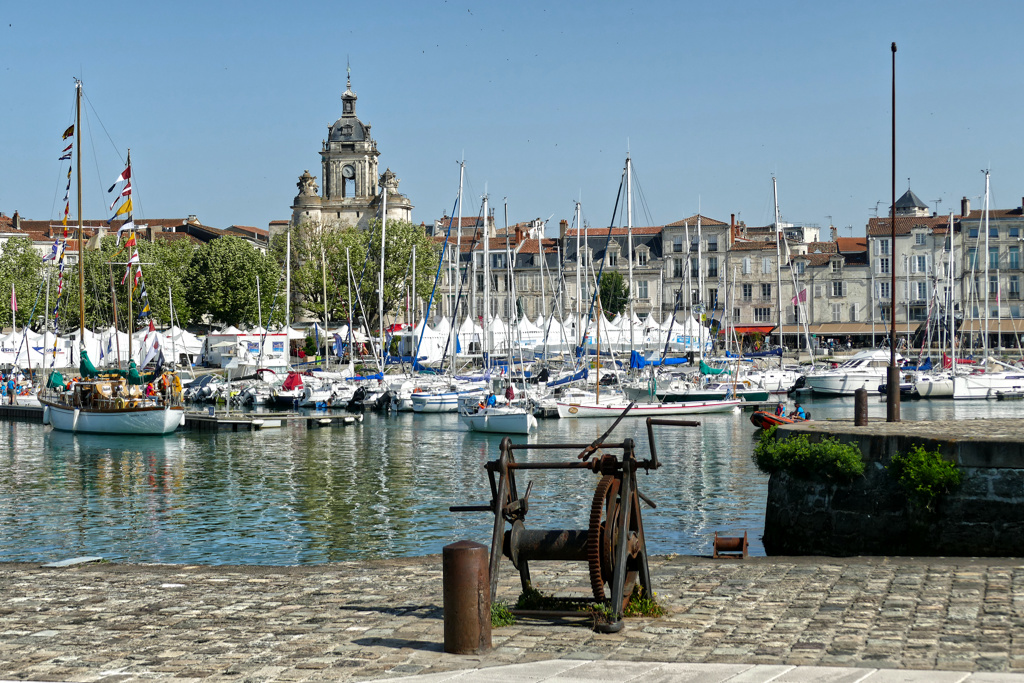
La Rochelle
The port city of La Rochelle in western France boasts a tumultuous history that earned it the nickname belle et rebelle, hence, beautiful and rebellious. Attributes that hold an immediate magnetic appeal for me.
Strategically situated on the Atlantic coast, the settlement founded in the 10th century rapidly evolved into a prosperous commercial hub. In the 12th century, the city rose meteorically under William X, the Duke of Aquitaine. It was granted extensive privileges as a free port, establishing it for centuries as France’s largest Atlantic harbor. International trade flourished, driven by the export of wine and salt. To safeguard this wealth, powerful fortifications were erected. To this day, the defensive towers at the old port still stand as reminders of that era.
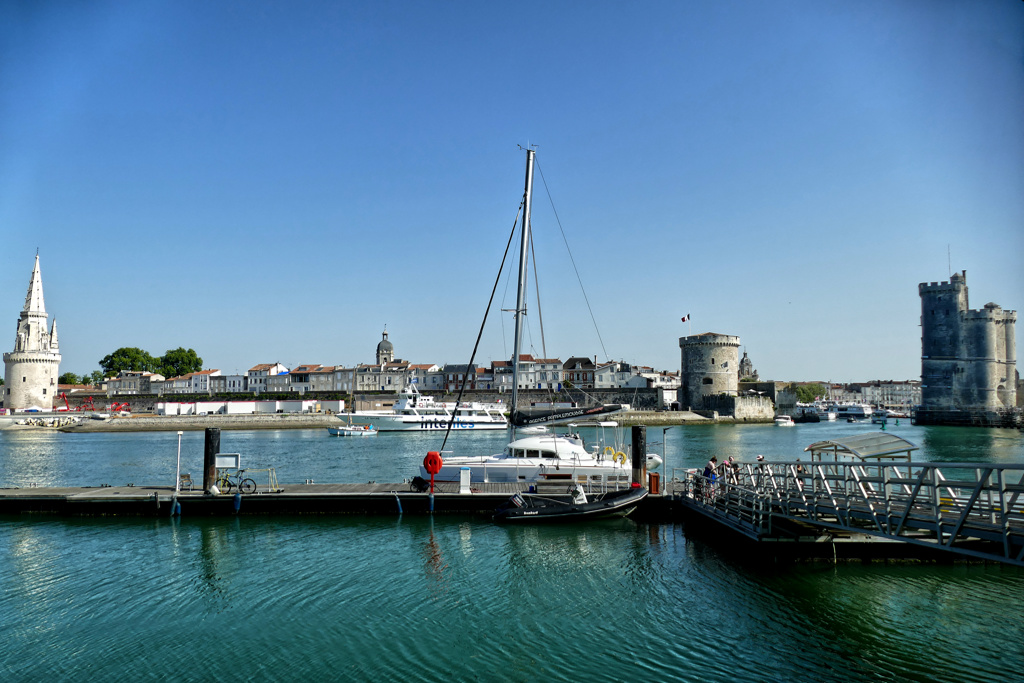
Interestingly, in 1199, the city also made history in the field of democracy by electing France’s very first mayor!
During the 16th century, La Rochelle embraced the Reformation and rose to become the impregnable capital of French Protestantism. This led to the siege by Cardinal Richelieu in 1627. Richelieu completely sealed off La Rochelle’s harbor with a sea dike. After 13 months of merciless famine that claimed the lives of three-quarters of the population, the city capitulated.
In the 17th and 18th centuries, La Rochelle’s harbor became a gateway to the so-called New World. It played a pivotal role in the colonization of Canada. However, the city also earned large sums of blood money during that era through the transatlantic triangular slave trade.
Bienvenue à La Rochelle
You probably wouldn’t guess that La Rochelle is home to Europe’s largest marina. The historic old town, and especially the promenades around the harbor basin, have a sophisticated yet unpretentious atmosphere. There’s nothing quite like strolling along the waterfront, feasting on fresh-caught fish on a restaurant terrace, sipping an ice-cold glass of white wine, and simply taking life easy.
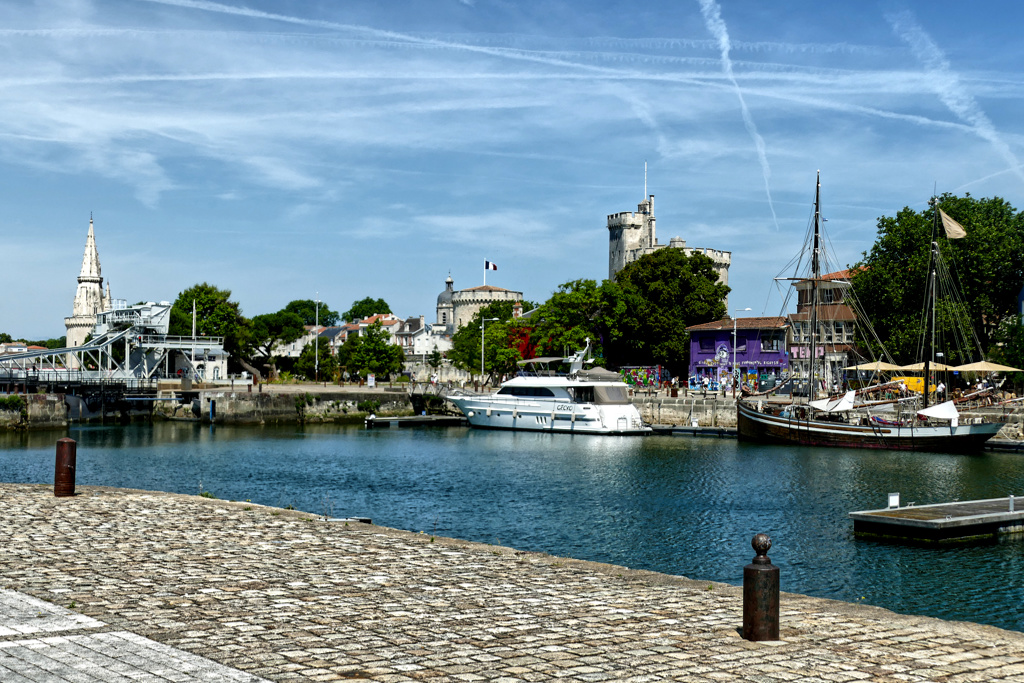
La Rochelle is wonderfully laid-back and relaxed. As a pioneer in urban sustainability, the city offers pedestrian zones perfect for a leisurely stroll. However, you can also take a lovely bike ride into the surrounding countryside thanks to a long-established bike-sharing system. You can even cycle all the way to the Île de Ré just off the shore of La Rochelle.
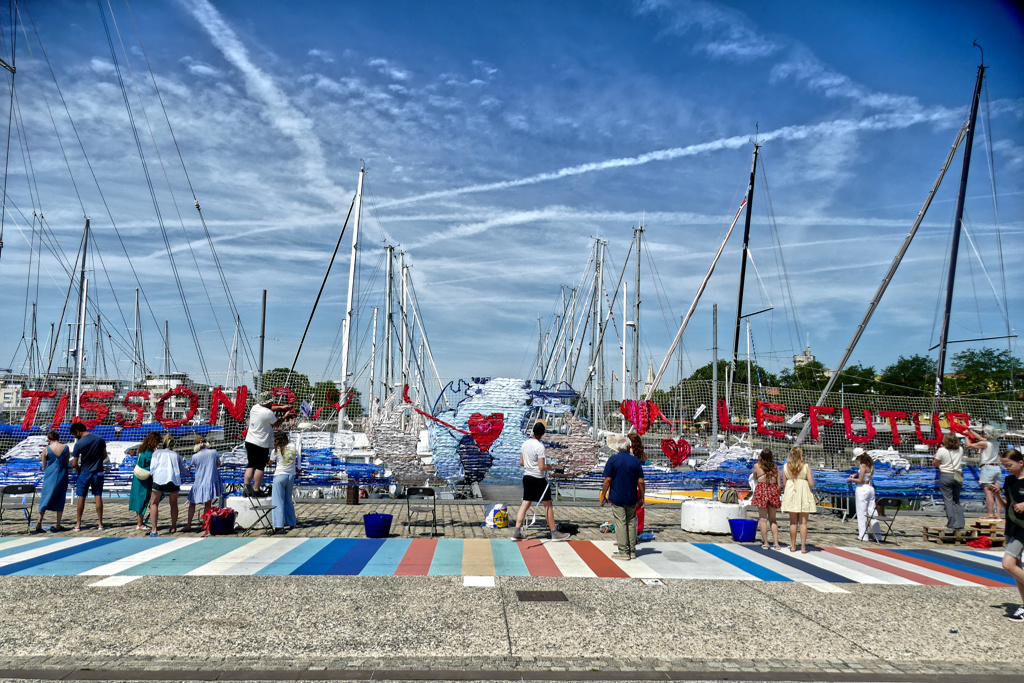
Considering that La Rochelle was only intended as a convenient stopover on my return trip from Île de Ré, it is amazing how this city on the Atlantic coast turned me into her biggest fan in just two days!
So take my word for it: forget the hectic, pricey Côte d’Azur and come to La Rochelle to truly unwind and just relish.
What Not to Miss in Two Days
As a matter of fact, this wasn’t my first time in La Rochelle. I was here a few years ago with my then-little daughter, but I hardly remember anything about it. I know it was spring and we’d arrived from Paris, where we’d braved hail in thick winter coats. Once we arrived in La Rochelle, it was already very warm. So warm, in fact, that I bought a new T-shirt and flip-flops for the both of us as we hadn’t packed the right clothes for such heat.
We relaxed for a while on the beach, and I was very impressed by a street lined with arcades. That’s what I specifically remember. But I also have a vague memory that I enjoyed it.
Now that I’m back, it’s summer, so I was expecting warm weather, meaning I don’t need any new outfit and can get straight to sightseeing.
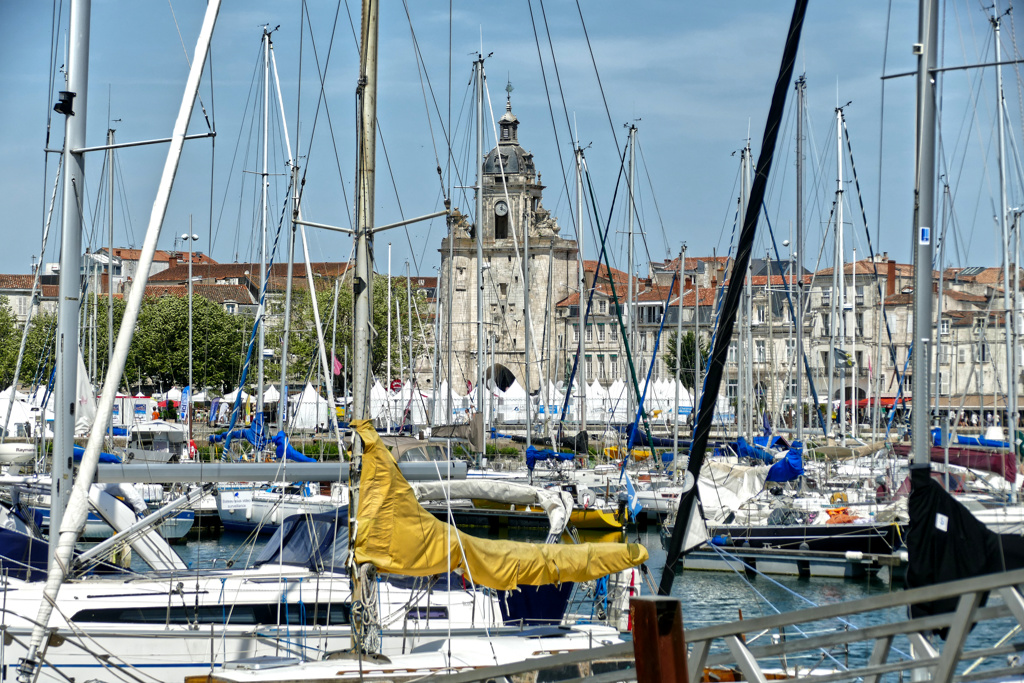
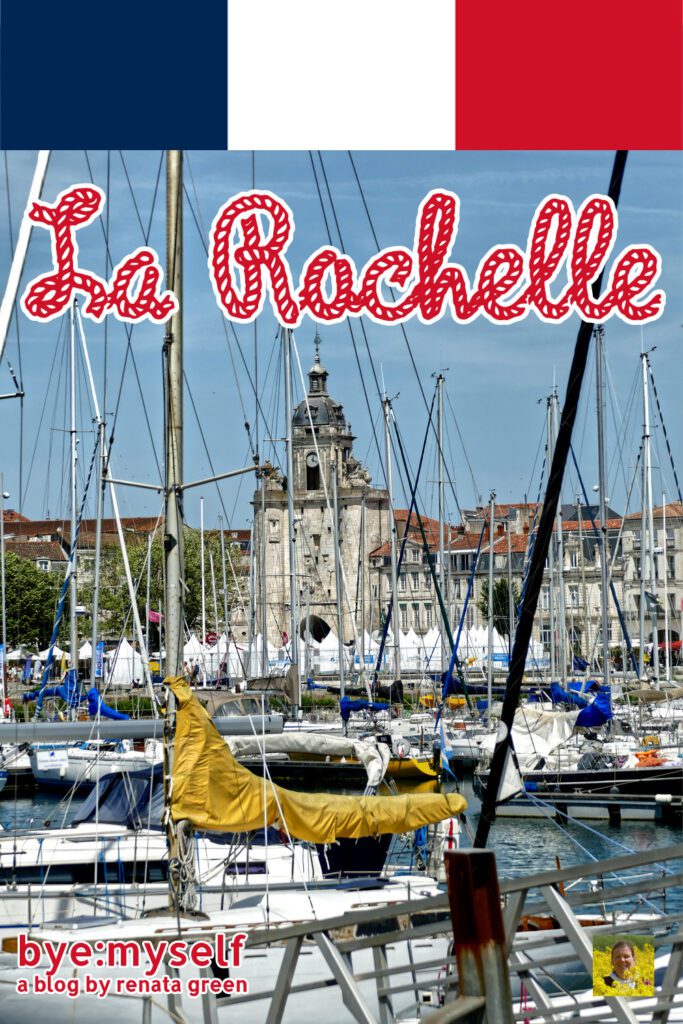
One of the key sights – geographically, historically, and ultimately also touristically – is the Vieux Port, the old port. It lies picturesquely within the imposing city walls, which are flanked by two towers facing the open sea.
Tower of Power
Today, the towers of La Rochelle stand as proud, solitary landmarks. They survived the demolition of the city walls. ordered by Louis XIII, only because they were indispensable for maritime navigation.
The most prominent of the three is the Tour Saint-Nicolas, standing 42 meters tall. It served the city as a fortified residential keep. Because it was built on extremely marshy ground, 14th-century builders had to drive oak piles deep into the mud. Nevertheless, the foundation subsided during construction, giving the structure a tilt that remains visible to this day.
The interior resembles an intricate labyrinth of double, interlocking spiral staircases and separate corridors within the thick walls. In the course of daily military operations, these separate routes ensured that soldiers, the tower commander, and high-ranking guests did not inadvertently cross paths. Over the centuries, the massive complex was later used as a prison for Huguenots and foreign sailors. Today, it is closed to visitors due to the lack of structural reinforcement in the foundations.
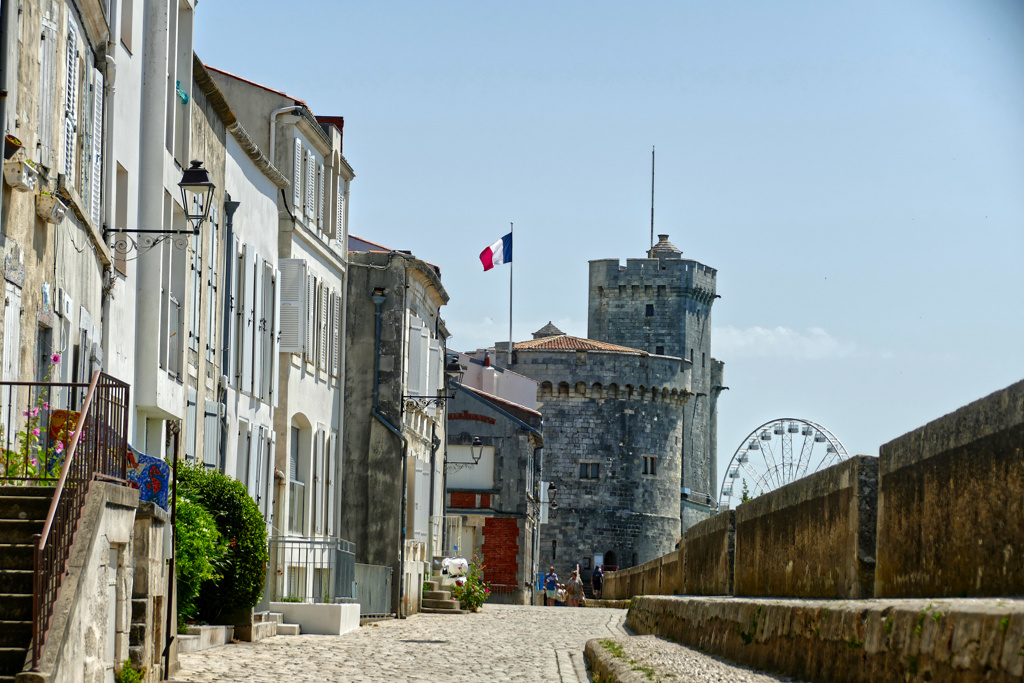
Directly opposite, at the historic harbor entrance to the Vieux Port, stands as its counterpart the Tour de la Chaîne. It owes its name to a massive iron chain that, during the Middle Ages, was stretched across the water to the Tour Saint-Nicolas every night to block access to the harbor basin. Today, the Chain Tower stands only 20 meters tall. However, it used to be 34 meters high and served as a gunpowder magazine. In 1651, a massive explosion destroyed its entire roof along with the magnificent captain’s quarters. After remaining a ruin for nearly 300 years, the upper platform was restored and slightly lowered in the 20th century. Today, the tower is a unique space for changing art exhibitions.
Shine a Light
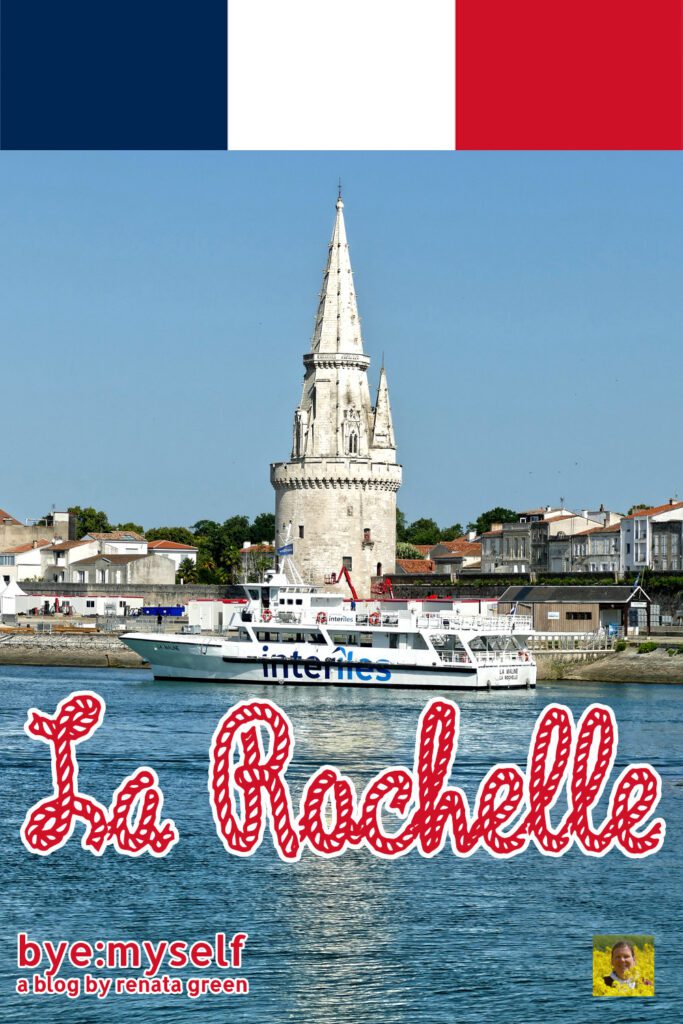
Last but not least, the Tour de la Lanterne rises to a height of 58 meters, making it the tallest of the three towers. It is the last surviving medieval lighthouse on the French Atlantic coast. Its unusual architecture consists of a massive cylindrical base topped by an intricate, octagonal Gothic spire. In its upper section, a flame burned behind glass.
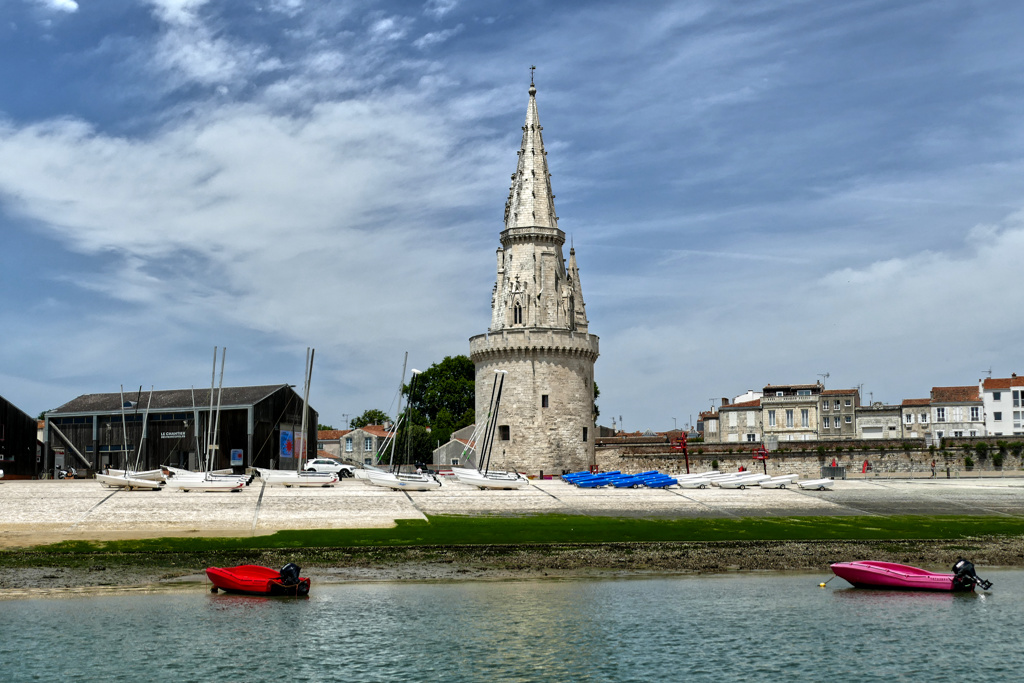
After ceasing to function as a lighthouse, the tower served for over three centuries as a notorious military and naval prison. More than six hundred pieces of historical graffiti on the interior walls bear witness to this era. They were intricately carved into the soft limestone by imprisoned English, Spanish, and Dutch buccaneers.
Fun Fact
In 1822, the Tour de la Lanterne acquired the additional name Tour des Quatre Sergents, Tower of the Four Sergeants in English. Four young sergeants from the La Rochelle garrison were imprisoned in the tower for their membership in the secret Carbonari society and their attempt to overthrow the monarchy. Eventually, they were guillotined in Paris.
Ironically, my favorite tower is one that most people don’t even pay attention to. The Phare du Quai Valin is an architecturally unusual lighthouse located right at the end of the Vieux-Port on Quai Valin. It was integrated right into a two-story residential building in 1852.
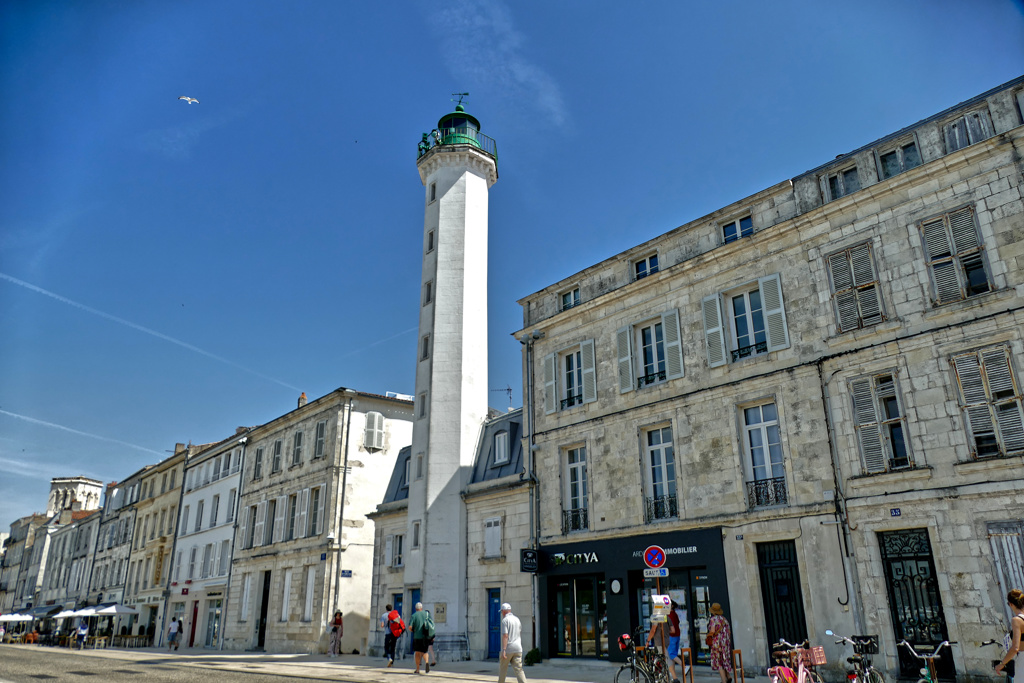
The tower, which stands over 24 meters tall, originally served as a leading light, helping sailors find the channel to safely enter the port of La Rochelle.
On the Water
As a matter of fact, I only got a really good view of the Tour de la Lanterne from the water, once I had left the city limits behind on a mini-cruise.
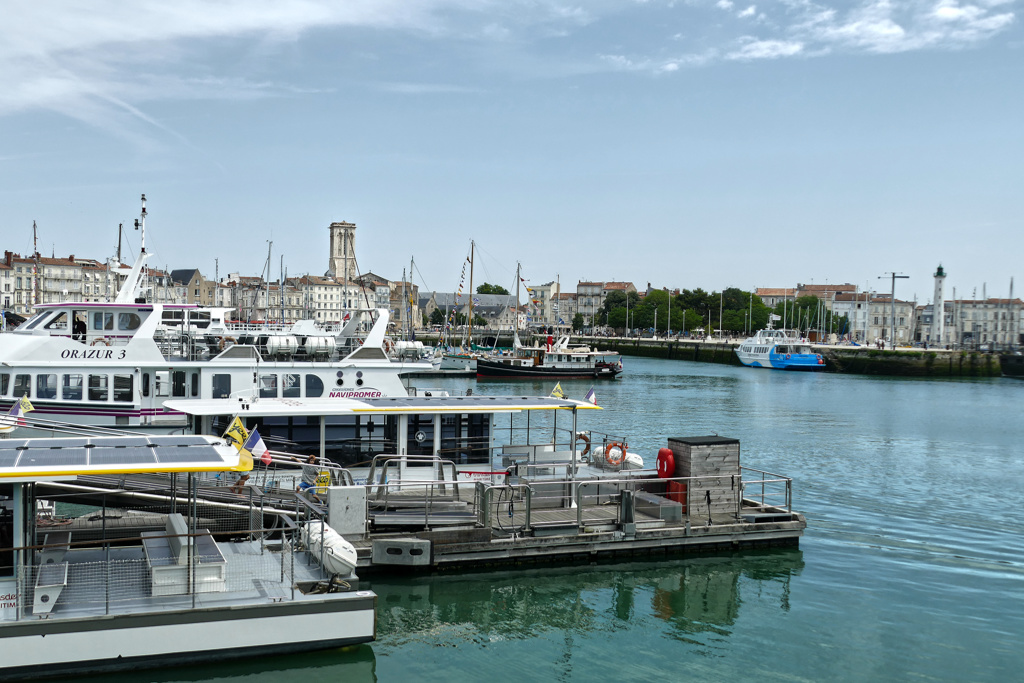
The Vieux-Port is the perfect starting point for a day trip on the water. For a longer excursion, there is a classic sightseeing cruise that heads straight out into the bay from the dock at Cours des Dames. This trip takes you right up close to the world-famous Fort Boyard and is ideally combined with a stopover of several hours on the car-free Île d’Aix. The crossing itself takes about an hour each way. During peak season and on weekends, boats depart several times a day. Usually, there is a morning tour around 10 a.m. and an early afternoon one around 2 p.m. A scenic round-trip cruise around the fort without an island stop costs just under 23 €uro, while a ticket that includes the stopover is around 30 €uro. You get more info and book your trip right here*:
Going Public
Ferries aren’t just for sightseeing excursions, though. For instance, there is a small electric solar-powered catamaran that runs between the harbor and the famous La Rochelle Aquarium. It shuttles back and forth almost continuously, acting almost like a floating bridge. The trip takes only a few minutes; while charming, it doesn’t quite qualify as a satisfying cruise. This shuttle, known as the Passeur, starts operating at 7:30 a.m. and runs until late in the evening. A one-way trip costs just €1.50, as it is part of the city’s public transport network.
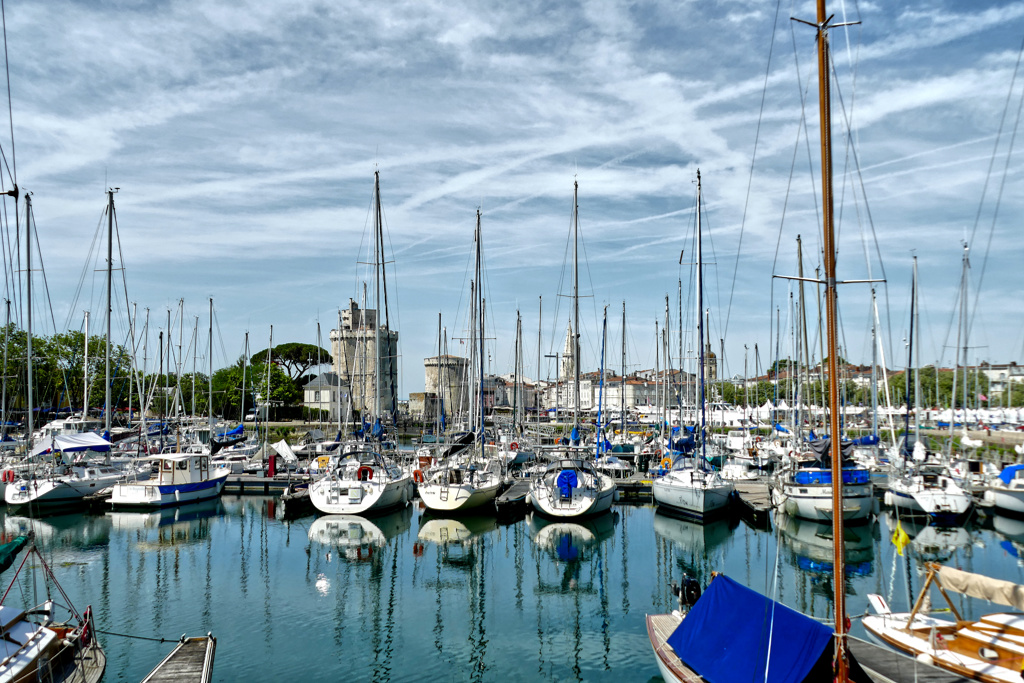
As I mentioned earlier, it was a hot summer day. To wind down at the beach, I opted for the city’s other public boat service, the so-called Bus de Mer. This larger electric vessel also departed from the Old Port, gliding majestically past the historic towers before taking me directly across the water in a far-too-brief twenty minutes to the large Port des Minimes marina. From the terminus there, it was just a short walk to the fine sandy beach of Plage des Minimes.
The water bus operates daily during spring and summer, running every half-hour or hour between 10 a.m. and 8 p.m. A single ticket to the marina costs €3. However, keep in mind that France is the land of the sacred lunch break. There are few other European countries where everything effectively shuts down at midday. This also applies to the Bus de Mer staff, obviously.
Life is a Beach
Yes, La Rochelle is incredibly charming and picture-perfect. But it is especially in summer that you really appreciate its Atlantic location. It takes barely ten minutes to walk from the city center and the Vieux Port to the local beach, Plage de la Concurrence. This charming little urban beach is the most famous and centrally located beach in La Rochelle, standing out thanks to its unique setting. Situated right below the Allées du Mail promenade, the beach offers a picturesque view of the bay, the red Richelieu Lighthouse, and the sailboats coming and going.
However, before you head to the beach full of anticipation for an extended swim, check the tides first. I am based in Northern Germany, so I am very familiar with tidal ranges. Yet, I have to admit I didn’t realize just how pronounced the tides are along the French Atlantic coast. More than once, I walked down to the cooling water, sweaty and eager to take a dip, only to find a vast expanse of mud instead. In fact, at low tide, the water recedes so far that swimming becomes impossible, and the bay transforms into a wide stretch of sand and rock. You also need to be a bit cautious when entering the water, as there are sharp-edged rocks and slippery stones beneath the sand that become exposed, especially at low tide. Wearing water shoes is therefore a good idea.
However, if the beach doesn’t quite live up to your expectations, the Parc Charruyer, with its shady walking paths, is located right behind the beach and is a great alternative.
Les Minimes
Plage des Minimes is larger and more scenic, offering more of a holiday vibe. It is located in the district of the same name, nestled between the huge marina and the expansive Pointe des Minimes park.
Although the Atlantic tides play a role here too, the water at Plage des Minimes does not recede as dramatically at low tide. This makes swimming possible for a much longer period of the day, without the need to chase the retreating sea for miles. Furthermore, the seabed here is much sandier and slopes more gently, meaning you are far less likely to encounter sharp rocks or slippery stones.
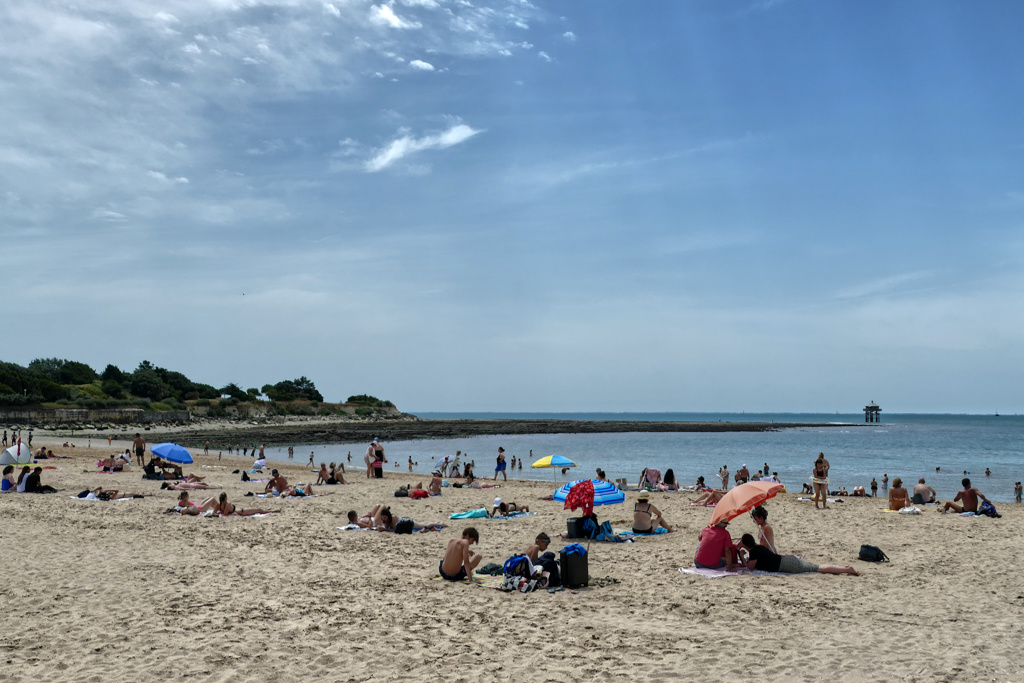
The infrastructure is excellent, featuring bathrooms and showers. If you don’t bring your own picnic, you can get refreshments at the neighboring cafés, restaurants, and ice cream parlors. Also, if you forgot some of your beach essentials, there are shops along the adjacent promenade and around the harbor basin. The journey there via the Bus de Mer from the Vieux Port adds a special touch to the experience, though a regular city bus also stops near the beach.
Aquarium La Rochelle
Even if you don’t hit the beach, you can enjoy the wonders of the sea. The La Rochelle Aquarium opened in 1988 and is one of the largest privately owned aquariums in Europe. Located near the city center, directly opposite the Vieux-Port, it’s arguably the city’s biggest tourist attraction. It houses around 12,000 marine animals from 600 different species, frolicking in an incredible 3 million liters of seawater!
The two-story exhibit takes you on a journey through the world’s oceans. The tour begins spectacularly with a glass jellyfish tunnel offering a 360-degree panoramic view. Next, you’ll enter the Atlantic section with its replica limestone cliffs and native marine life. This is followed by exhibits on the Mediterranean, the Caribbean deep sea, and the Indo-Pacific. For many, the shark tank is the absolute highlight. However, the aquarium is also deeply committed to environmental protection.
The aquarium is open daily, with seasonal hours typically ranging from a.m. to p.m. In July and August, the aquarium also offers special evening opening hours from 8:30 a.m. to 11:00 p.m. Regular admission is €18.50; unfortunately, the La Rochelle Océan Pass* only offers a very small discount of €2.
My Tip
If possible, you should buy tickets online in advance. The aquarium uses a timed entry system with fixed time slots, so buying a ticket directly at the ticket office does not guarantee immediate entry.
The Old Town
The historic city center of La Rochelle isn’t very large, but I find it truly beautiful. The entire region lies atop gigantic limestone deposits dating back to the Jurassic period. Because the rock was locally abundant and also exceptionally easy to carve and work, it was used for centuries to build fortresses, churches, and townhouses. Especially during the Renaissance, this soft stone allowed builders to adorn the facades of the old town with extremely delicate, artistic ornaments, reliefs, and sculptures.
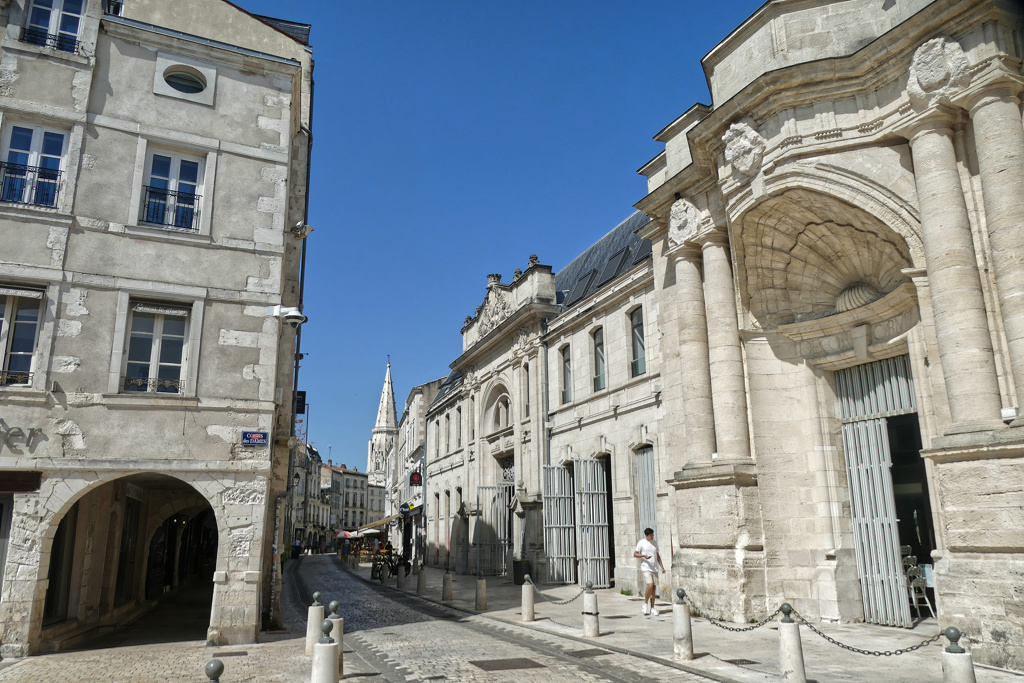
The light-colored limestone also reflects the intense light of the Atlantic coast particularly well. Depending on the time of day, the magnificent historic buildings, the famous medieval watchtowers at the harbor, and the characteristic arcades of the pedestrian zones change their appearance. During the day, they gleam a dazzling white, and in the evening, they glow with a warm, honey-yellow hue.
And it was ultimately this exquisite building material that earned the port city its nickname, La Ville Blanche, hence, The White City.
Porte de la Grosse Horloge
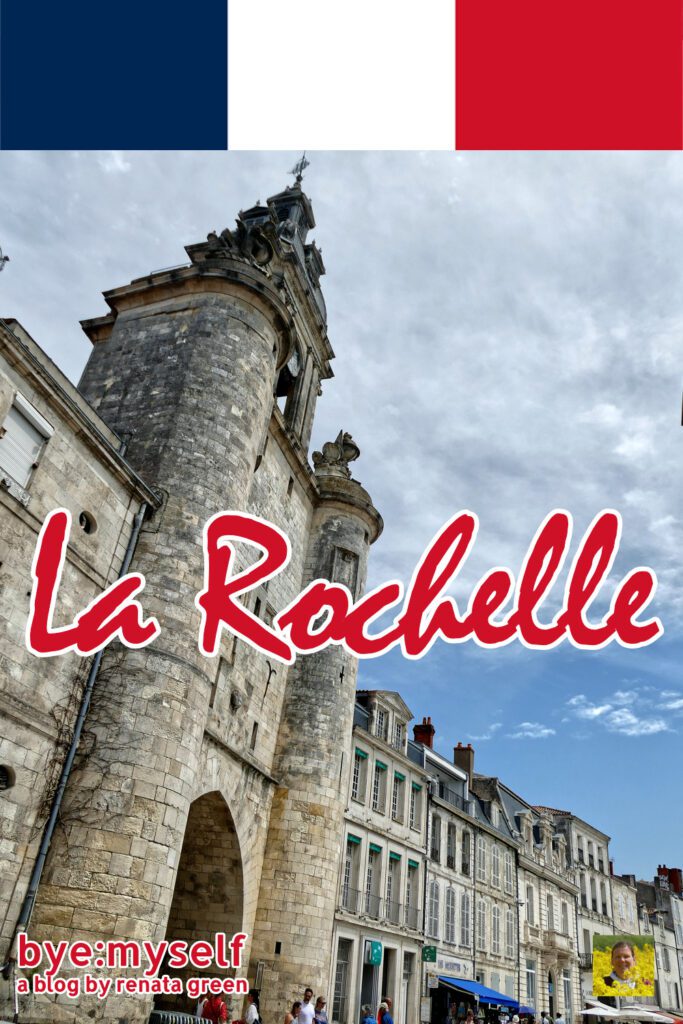
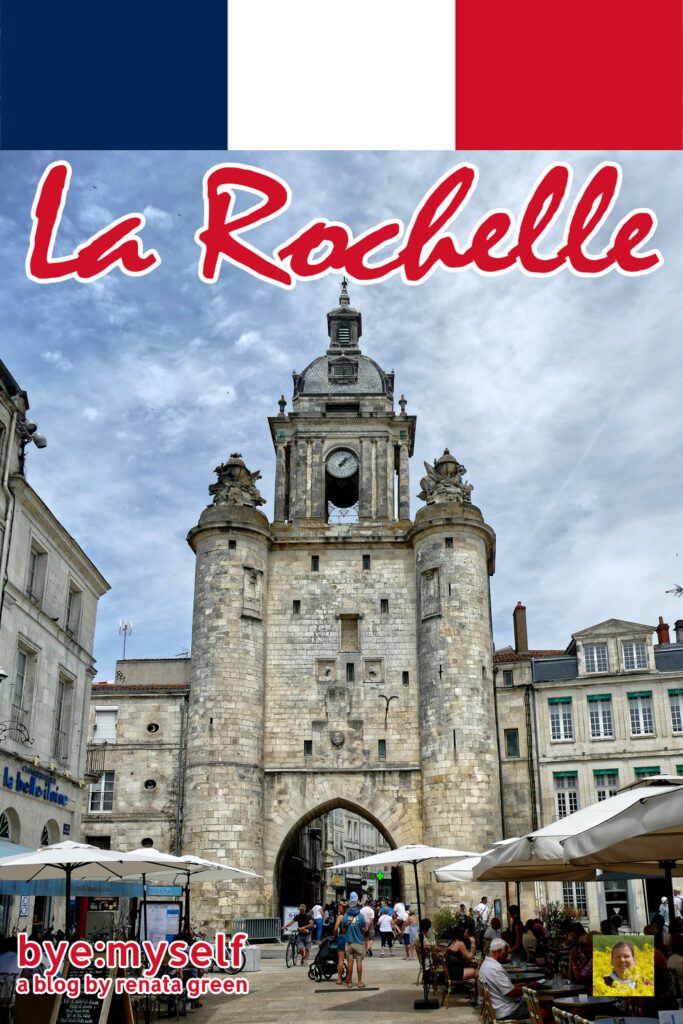
To leave the historic old port and enter the old town, you must inevitably pass through the imposing, semicircular archway of the Grosse Horloge. Like a triumphal arch, the gateway connects the quays with the Rue du Palais. It is precisely here that the network of covered arcades begins.
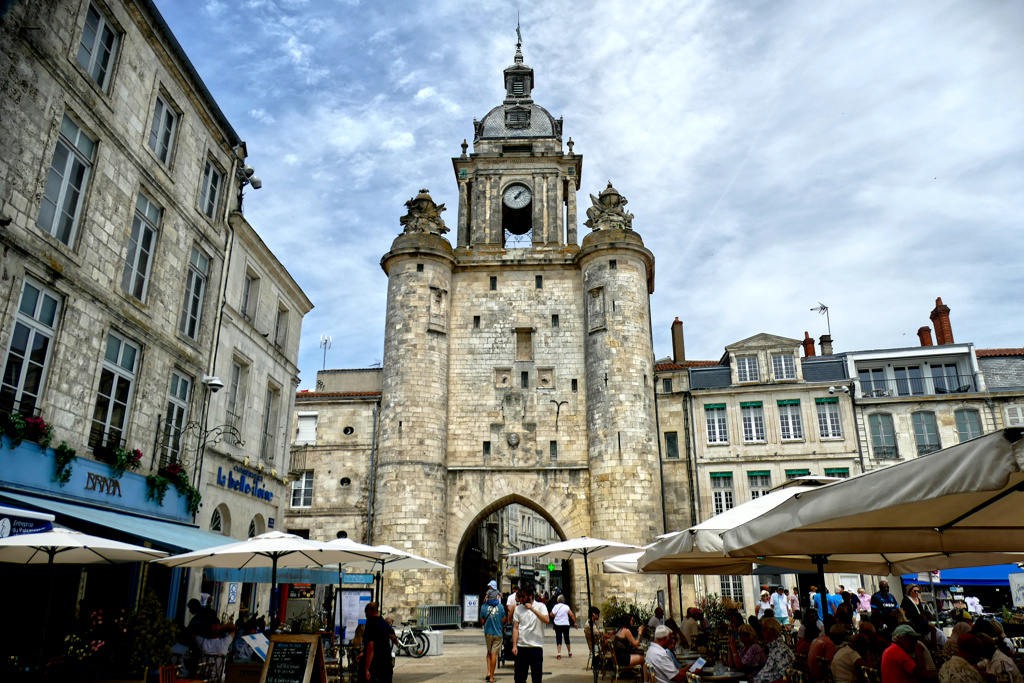
The Grosse Horloge thus functions not only as a physical gateway but also as a timekeeper for the entire city. The grand arch of the gateway literally opens the way for visitors into a world that continues rhythmically in the streets below, with hundreds of smaller arches. When the intense light of the Atlantic Ocean hits the bright limestone of the gateway, illuminating its facade, the Grosse Horloge becomes the perfect symbol of La Rochelle. It is a masterpiece in stone that combines the maritime history of the port with the elegant world of commerce within the arcades.
Les Arcades
Ironically, it’s the historic arcades that, besides the forced clothing purchase, are what I remember most vividly from my first visit to La Rochelle. And this time, too, I found this striking and fascinating architectural feature among the most impressive.
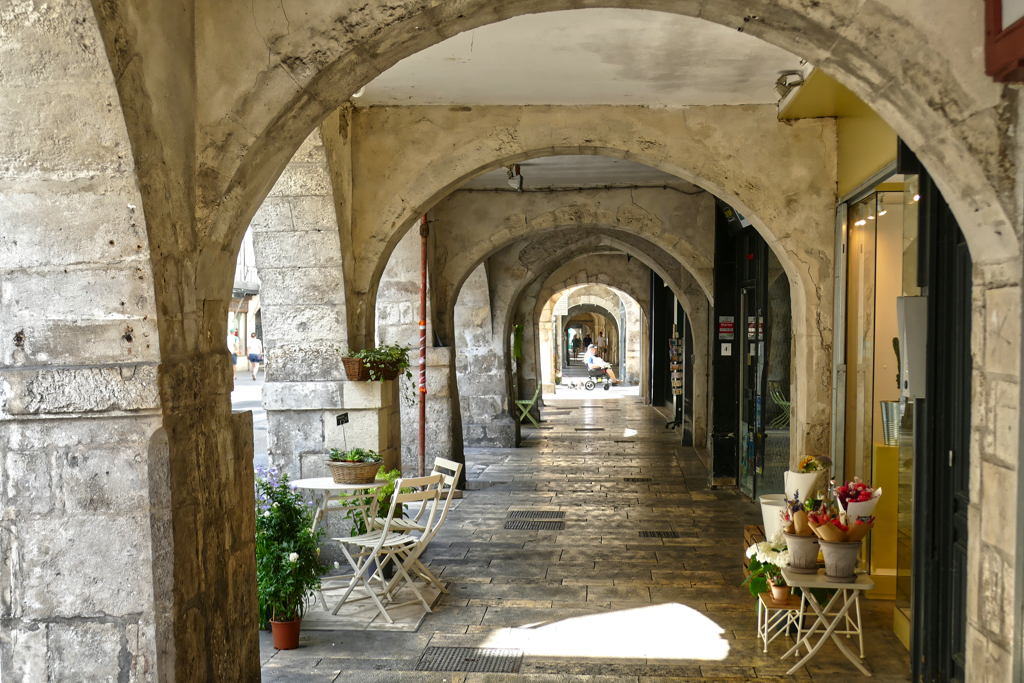
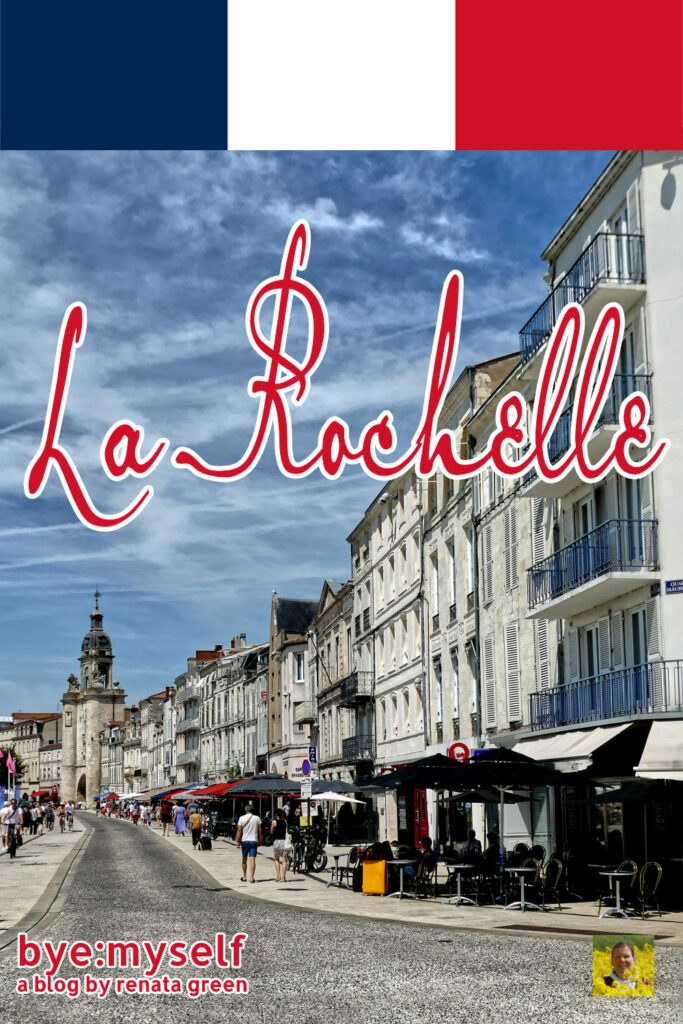
The arcades stretch for several kilometers through the pedestrian zones of the old town. They lend La Rochelle an almost Italian flair. Yet their roots lie in the very pragmatic trading history of the port city in the Middle Ages. When La Rochelle rose to become one of the most important trading ports in France in the 12th and 13th centuries, there was an acute shortage of space in the narrow streets within the city walls. Merchants originally displayed their goods on tables directly in front of their houses on the already narrow streets. To create more sheltered sales space, the merchants simply extended the upper floors of their half-timbered houses and limestone buildings forward. Massive pillars and round arches supported these overhangs. Merchants could display their wares outdoors, protected from the elements, while customers strolled in the dry, and the actual street traffic in the center remained unobstructed.
Bow by Bow
Architecturally, the arcades’ fascinating mix of styles reflects the city’s long and varied history. The oldest sections date back to the Gothic and medieval periods. They are characterized by heavy, low stone arches and, in some cases, rustic wooden beams. In contrast, there are the elegant, high, and wide arches from the Renaissance and the 18th century, crafted from the region’s typical light-colored limestone. Since property owners at that time had to pay taxes based on the width of their street-facing facades, many built their houses very narrow, but extending deep into the alleyways. This gives the arcades their characteristic, rhythmic appearance today.
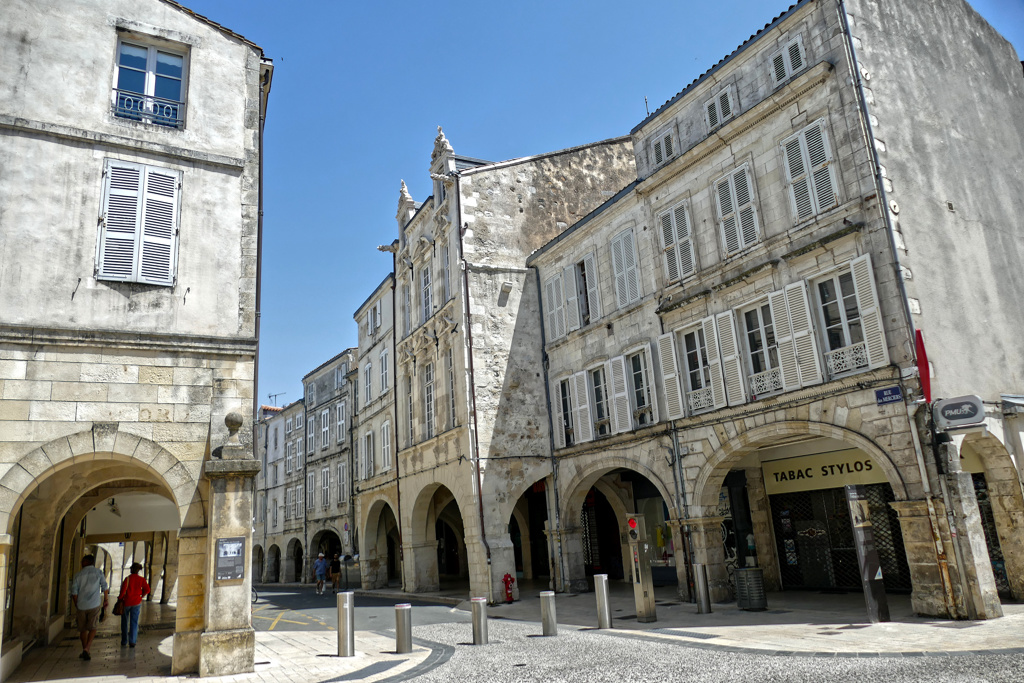
The arcades have never lost their original function as shopping streets. Even today, they house exquisite boutiques, traditional shops, bookstores, and cafés. They protect passers-by from the intense midday sun or the sudden rain showers brought in from the sea by the westerly wind.
Les Halles de La Rochelle
As you follow the arches into the heart of the city, you will inevitably arrive at the Halles de La Rochelle. This historic market hall is far more than just a place to shop. It is a living cultural monument and the culinary heart of the city. Here, the agricultural treasures of the hinterland combine with the fresh produce of the Atlantic to create a feast for the senses.
Architecturally, the halls form a fascinating bridge between tradition and modernity. The current building was erected in 1836 on the site of the city’s very first covered market, dating back to the 14th century. The monumental façade, befitting its status, is constructed of the typical light-colored regional limestone and, with its elegant round arches, blends perfectly into the cityscape dominated by arcades. The interior of the hall, however, surprises with a delicate and expansive roof structure made of cast iron and glass, which was revolutionary for the 19th century. This construction ensures that the market stalls are always bathed in natural light.
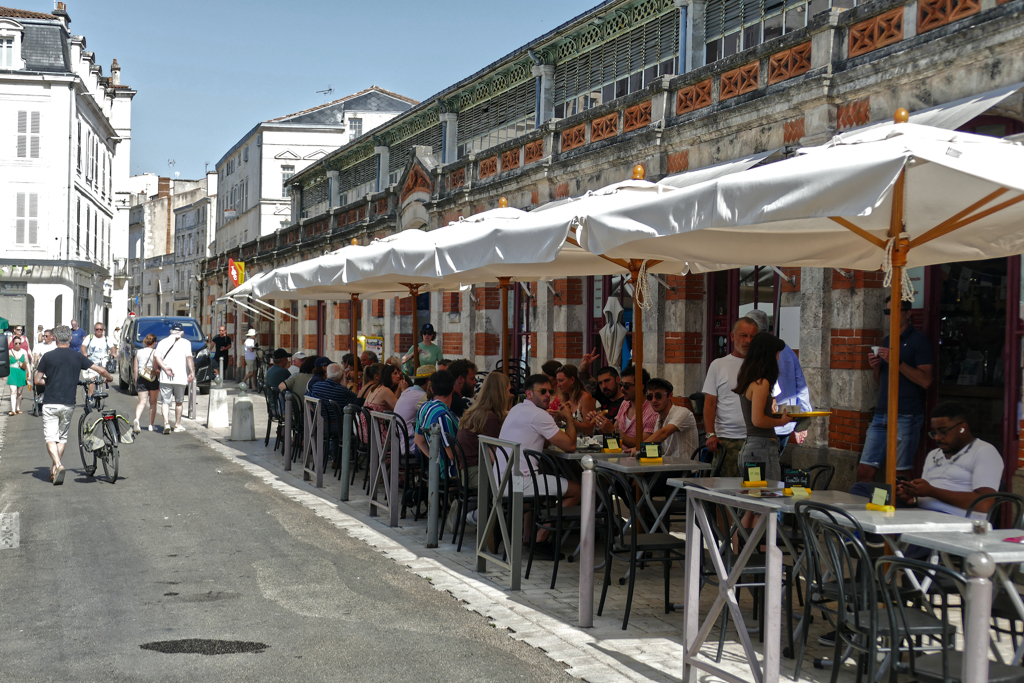
The true spectacle of the market halls, however, unfolds in the vendors’ displays. As a port city steeped in tradition, La Rochelle is synonymous with absolute freshness. This is particularly evident at the opulent fish and seafood stalls. These maritime delicacies are complemented by regional specialties from Poitou-Charentes, such as creamy goat cheese Chabichou, the famous butter from Échiré, fresh marsh vegetables, and the island’s signature potatoes.
The market hall is open every morning, but it reaches its absolute peak on the major market days, Wednesdays and Saturdays. On these days, the entire area transforms into a vibrant, bustling open-air experience. Locals gather here not only to shop but also to enjoy a glass of the regional aperitif, Pineau des Charentes, and to celebrate the proverbial French joie de vivre.
Maison Henri II
The Maison de Henri II is an architectural masterpiece of the Renaissance, dating from 1555. This somewhat hidden building was erected by the royal prosecutor Hugues Pontard on the foundations of an older 13th-century residence. His son, François Pontard, later mayor of the city, also lived in the house and, from here in 1567, made the momentous decision to officially align La Rochelle with the Protestant party during the Wars of Religion.
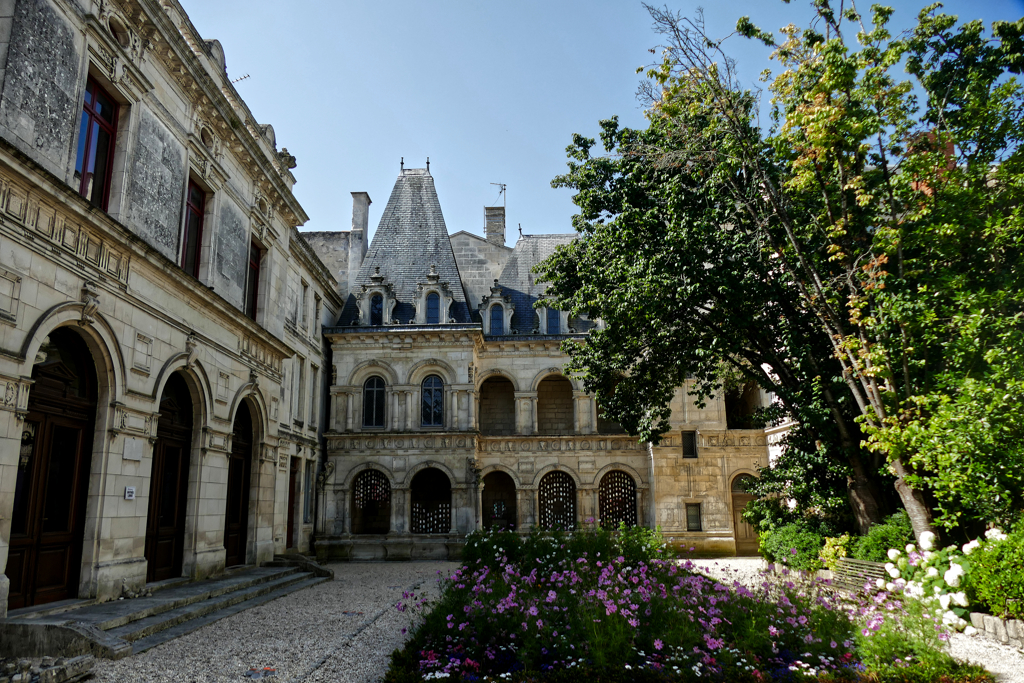
Architecturally, the residence combines two pavilions of different heights, connected by an elaborate, two-story gallery and loggia system. The facade decorations in the courtyard show strong Italian influences and feature extraordinary reliefs of moons and animal skulls, reminiscent of ancient Roman tombs. After being used for many years by a local archaeological society, it now houses the Centre Intermondes, an international center and residency for contemporary artists. Therefore, the interior is closed to the public, obviously.
Fun Fact
The name Henri II refers solely to the architectural style of that era. The king himself never entered the building.
Musée du Nouveau Monde
The most interesting museum in La Rochelle is undoubtedly the Musée du Nouveau Monde, hence the Museum of the New World. Founded in 1982, it is dedicated to the historical, economic, and artistic connections between France, and especially the port city of La Rochelle, and the Americas since the 16th century. La Rochelle was the second most important French slave port after Nantes, after all!
The museum is housed in the magnificent 18th-century Hôtel Fleuriau. The choice of location carries deep symbolism, as the building once belonged to Aimé-Benjamin Fleuriau, a wealthy merchant from La Rochelle. He made his fortune through the sugar trade in the former colony of Saint-Domingue, present-day Haiti, exploiting slaves.
The opening of the Musée du Nouveau Monde attracted nationwide attention, as it was the first French museum to address, without historical extenuations, the involvement of a French port in the infamous transatlantic triangular trade in the Caribbean.
The museum is open from 10 a.m. to 6 p.m. Wednesday through Monday, and from 2 p.m. on Saturdays. General admission is 8 €uro. A great option for culture enthusiasts is a combo ticket for 18 €uro. It covers admission to all four of the city’s museums and is valid for one month. Yet, holders of the La Rochelle Océan Pass* also have free entry.
Day Trip to the Île de Ré
A day trip from La Rochelle to Île de Ré is a great idea, as the island is flat, beautiful, and perfectly suited for a car- and carefree excursion. Whether you explore by bus or bicycle, both options have their pros and cons.
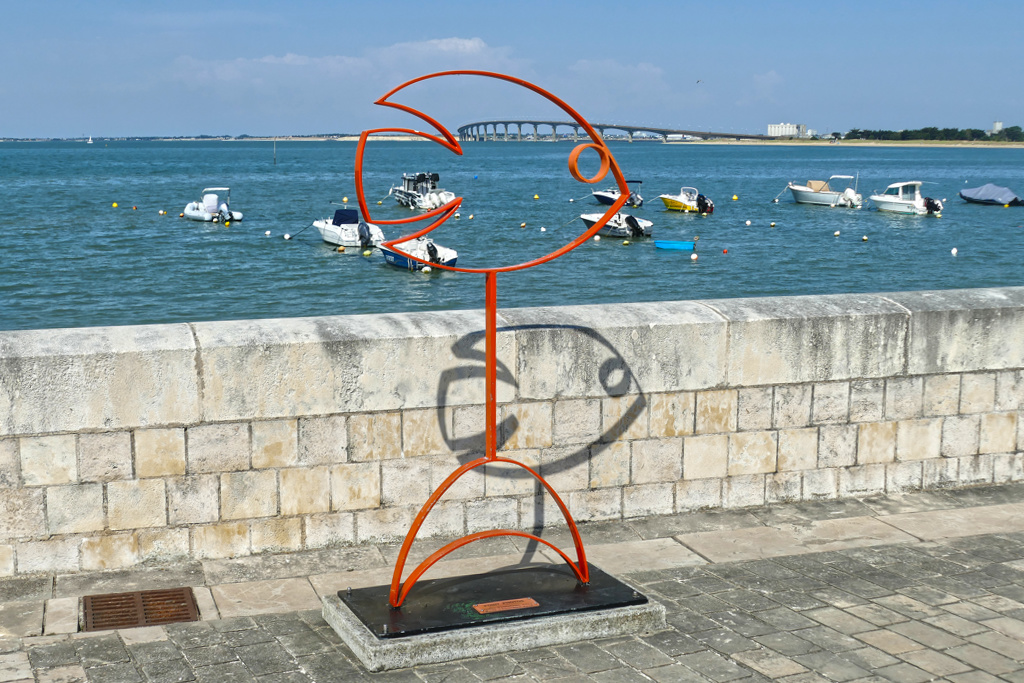
Taking the bus is the most comfortable option, obviously, especially if you want to see as much of the island as possible without strenuous cycling. Bus #150 runs daily year-round. It departs directly from La Rochelle train station and crosses the Pont de l’Île de Ré bridge. On the island, it stops in all ten villages, all the way to the westernmost point at Les Portes-en-Ré. The trip to the first village after the bridge, Rivedoux-Plage, takes about 30 minutes. From there, it’s approximately 90 minutes to the final stop in the northwest. Regardless of the distance traveled, a single ticket costs 2.50 €uro, and a return ticket costs 4.50 €uro. You can purchase tickets from the driver or via the Ticket Modalis app.
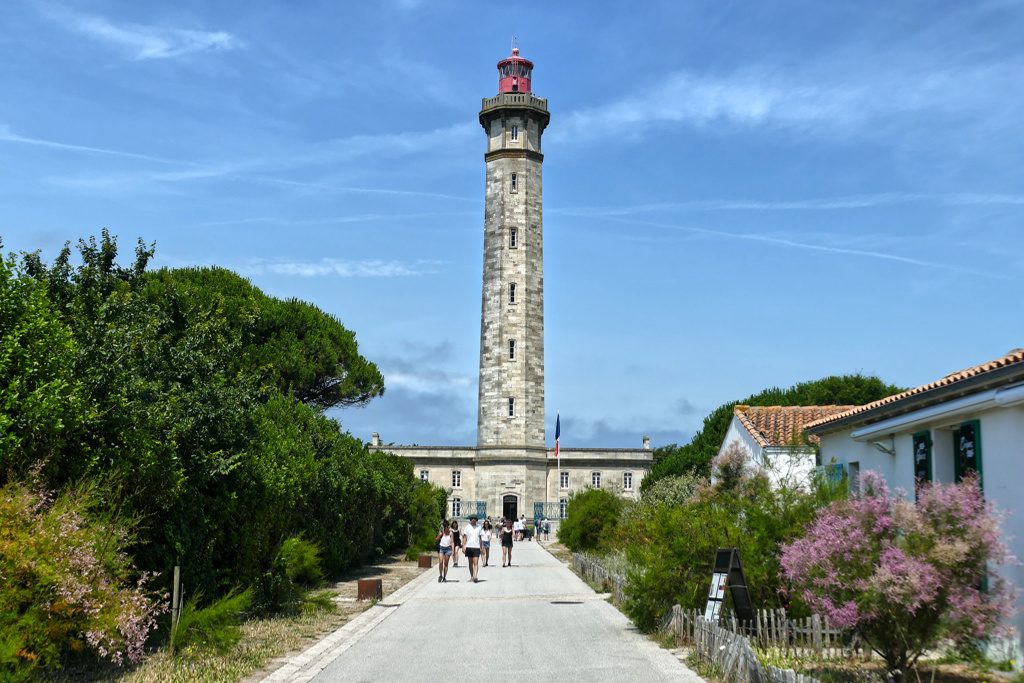
During the summer months, the Respi’Ré shuttle buses also operate within and between neighboring villages such as Saint-Martin, La Flotte, and Le Bois-Plage. While they are free, I wouldn’t recommend them for a day trip that requires some planning.
Getting a Bike
Île de Ré is a cyclist’s paradise, boasting a network of nearly 140 kilometers of excellent cycle paths. These paths lead away from the main roads, through salt marshes, pine forests, and vineyards. You can rent a bicycle directly in La Rochelle and cross the nearly 3-kilometer-long Pont de l’Île de Ré yourself. Here, too, the cycle path is separated from car traffic. While cars have to pay a toll, crossing is free for cyclists and pedestrians. Alternatively, you can simply take the bus to the island and rent a bicycle from one of the local rental shops.
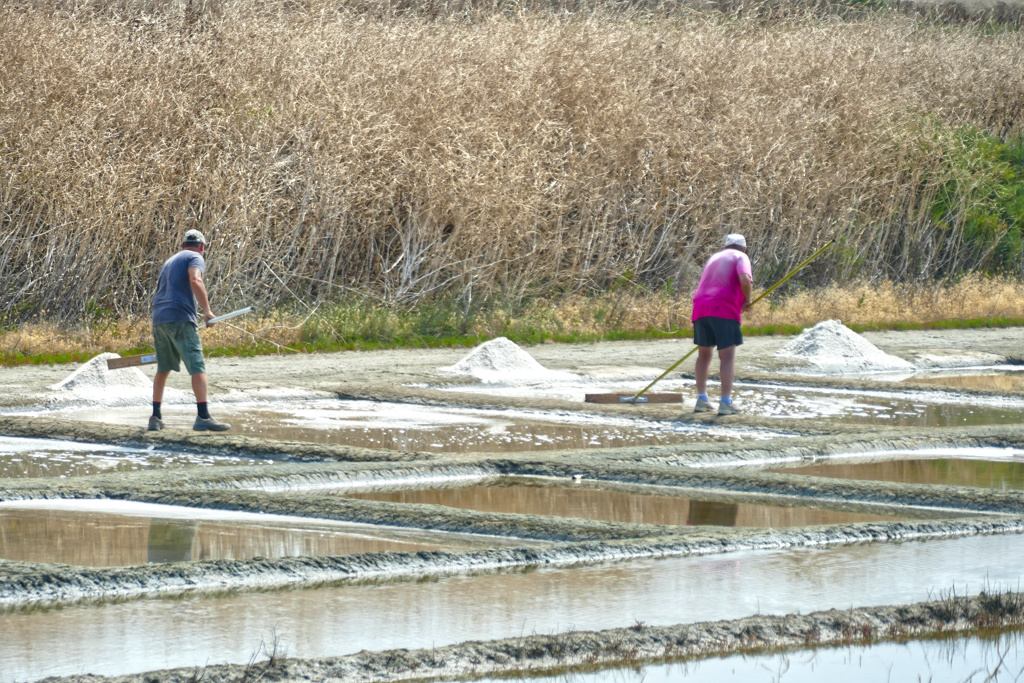
The island is flat, and cycling is mostly easy. However, you shouldn’t underestimate the distances and especially the sometimes strong Atlantic winds. Therefore, cyclists who are not in good shape should definitely opt for an e-bike.
I spent three days on the island and can therefore give you lots of good tips for your stay and getting around, both by bike and bus, in my post Glamping on the ÎLE de RÉ.
Practical Information
How to Get There
By Air
The La Rochelle-Île de Ré Airport is located about five kilometers northwest of the city center. Airlines such as Ryanair, easyJet, and Jet2 serve it seasonally. Hence, if you cannot find suitable direct flights to this regional airport, you can simply opt for the larger international airports in Nantes, which is around 140 kilometers away, or Bordeaux, about 190 kilometers away. From there, you continue to La Rochelle by train.
To get from the airport to the city center quickly and cheaply, just hop on a public bus. The stop is located right in front of the airport terminal, and the trip takes around 15 minutes. A single ticket costs 1.50 €uro and you can obtain it from the driver using a card or contactless payment. Note that you cannot pay cash.
Of course, you could also take a cab, but in most cases, that would simply be a waste of money.
By Land
La Rochelle’s main train station, Gare de La Rochelle, is centrally located and offers direct connections to the French high-speed and regional rail network. For example, there are several direct connections daily to Paris, Bordeaux, and Nantes.
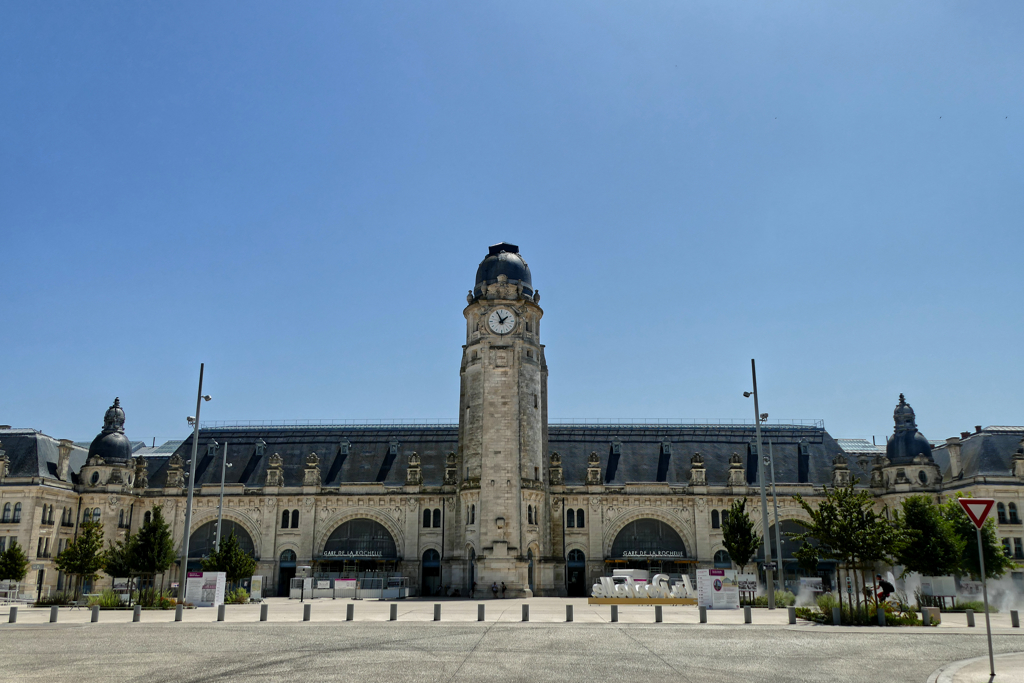
La Rochelle is also served by long-distance buses operated by companies such as FlixBus and BlaBlaCar. The long-distance bus stop is located at the Pôle d’échanges Jean Moulin bus station, directly behind the train station.
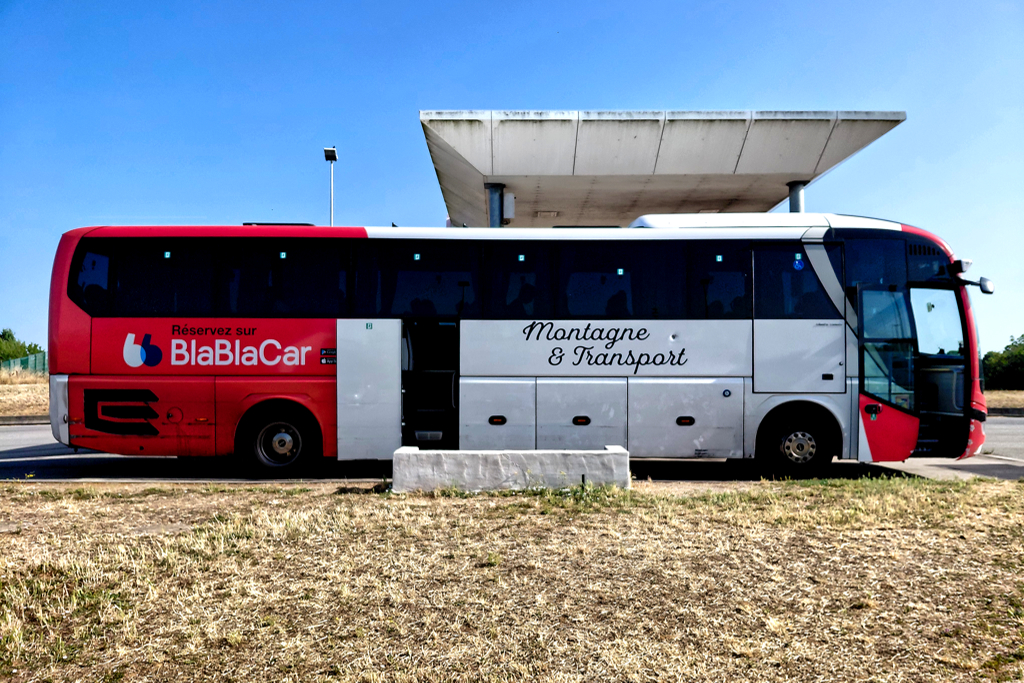
The network includes over 40 direct connections to major French cities such as Paris, Bordeaux, Nantes, and Rennes. International connections generally require a transfer at the major bus stations in Paris, Bordeaux, or Marseille, resulting in very long travel times.
By Sea
As a port city, La Rochelle is naturally also accessible by sea. Western European cruise ships call at the port. However, since the historic city harbors are too shallow and narrow for modern cruise ships, the shipping companies use the deep-water port, Grand Port Maritime de La Rochelle, located about five kilometers west of the city center.
For private arrival by sea, the Port des Minimes is a good option. With over 5,000 berths, it is one of the largest recreational harbors in Europe and has special berth areas for visitors. From there, the Bus de Mer provides a direct waterway connection to the historic Vieux-Port.
How to Get Around
The area of La Rochelle relevant to tourists isn’t very large. If you enjoy walking, you can easily explore the city center on foot.
However, La Rochelle also has a well-developed bus network. Buses run at varying frequencies depending on the line and day of the week, typically every 10 to 15 minutes on weekdays. On Sundays and public holidays, the schedule is significantly reduced, with only select lines running hourly or every two hours. It’s best to plan your journey using Google Maps or the Yélo app.
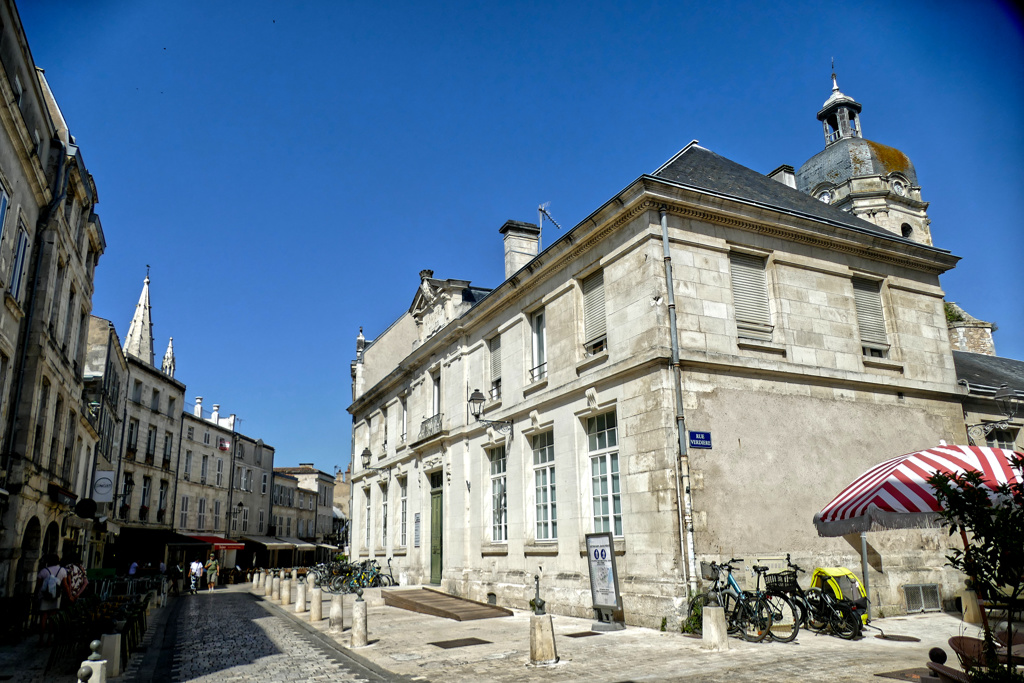
A single ticket costs €1.50 and is valid for one hour after the first validation, including transfers. It’s the only ticket you can buy directly on the bus with a credit card or contactless payment. A day pass, which allows unlimited travel on the entire network, is also available for €5.00. If you travel frequently but don’t need a day pass, there’s also a 10-trip ticket for €13.00. The two passes are available from vending machines at central locations such as Place de Verdun or the train station. You can also get them at over 60 tobacco shops and kiosks, and of course in the Yélo app.
Visiting Organized
Although I’m an avid solo-travelling woman, I sometimes like to join organized tours. This way, I get extended info about a place, and it’s fun to visit landmarks in the company of like-minded fellow travellers. Here are some ideas for activities to choose from*:
Where to Stay
It was during my trip to Provence that I first realized just how popular aparthotels are in France. Honestly, I’d argue that no other European country has so many different hotel chains offering self-catering rooms. In most cases, you get a standard hotel room, but with a kitchenette, complete with a fridge, two stovetop burners, a microwave, a coffee maker, and dishes and cutlery for two. Sure, some people might need a moment to get used to the idea of sleeping next to a stove. But I love it! No, not the sleeping-next-to-a-stove part, but the convenience of being able to brew a coffee in my pajamas first thing in the morning and enjoy breakfast in bed – just like on Mother’s Day.
Beyond that practicality and comfort, it also makes the stay much more affordable. You pick up a few things at the supermarket and live like royalty. Of course, that doesn’t mean you have to eat every meal on your lap in front of the TV. But for me, the ability to have a light snack in the evening instead of a heavy dinner and, above all, to start the day in a relaxed way with a coffee in bed is priceless.
Home Away From Home
I fully enjoyed the comforts of the Lagrange Apart’Hotel l’Escale Marine* in La Rochelle, among many other cities. It is about a 15-minute walk from the Vieux Port. Alternatively, several bus lines run right around the corner, in case you’re too tired to walk back in the evening. They also offer breakfast for about 11 €uro, but I can’t tell you how it is since I loved preparing my own breakfast in my room exactly the way I like it.
Another really nice feature is their small swimming pool with a sun-top that can be opened weather permitting. No, you can’t train for the Olympics in it, but it’s a welcome option to swim a few relaxed laps after a long day of sightseeing.
If the Lagrange Apart’Hotel l’Escale Marine* is fully booked, you’re sure to find another nice place to stay on this map that suits your needs and budget*:
Where to Eat
When it comes to top-notch dining in La Rochelle, the Cours des Dames and the adjacent Rue Saint-Jean du Pérot are the city’s absolute hotspots. Both streets are located right on the Vieux-Port (Old Port) and together form the culinary heart of the city for locals and visitors alike.
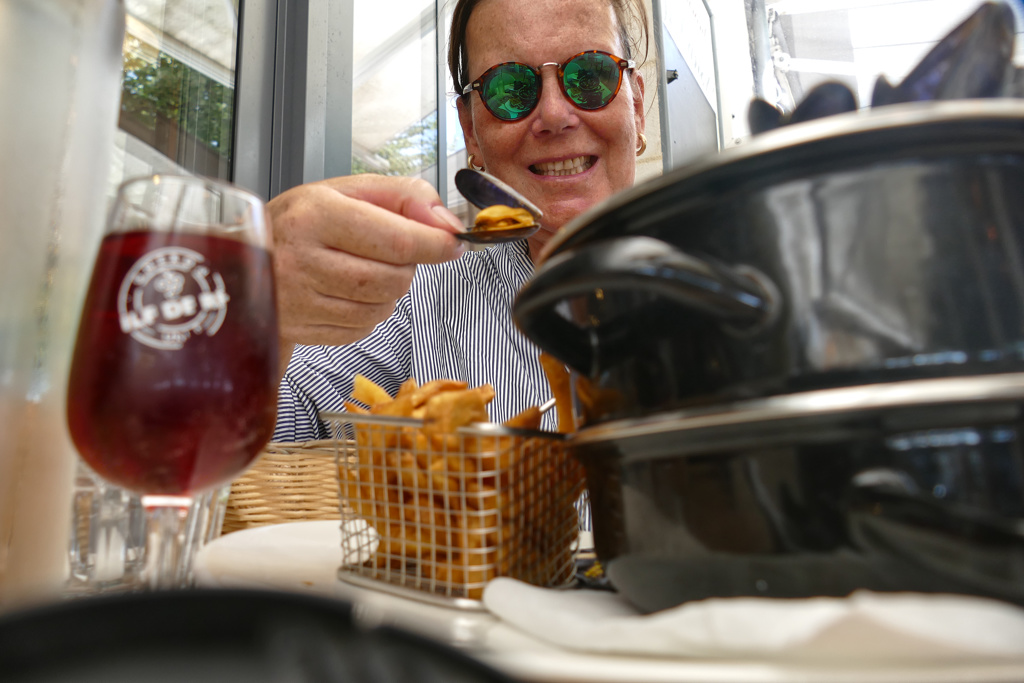
The wide Cours des Dames runs directly along the harbor basin and offers unobstructed views of the famous historic towers. The restaurants here take full advantage of the location. Large outdoor terraces are a common sight, where you can enjoy seafood delicacies along with a fresh sea breeze and the lively activity on the quayside. The culinary focus on the Cours des Dames is on traditional maritime cuisine. Traditional restaurants serve freshly caught fish, oysters, and the regional staple, moules frites, hence mussels and fries. Charming crêperies and long-established ice cream parlors can also be found here.
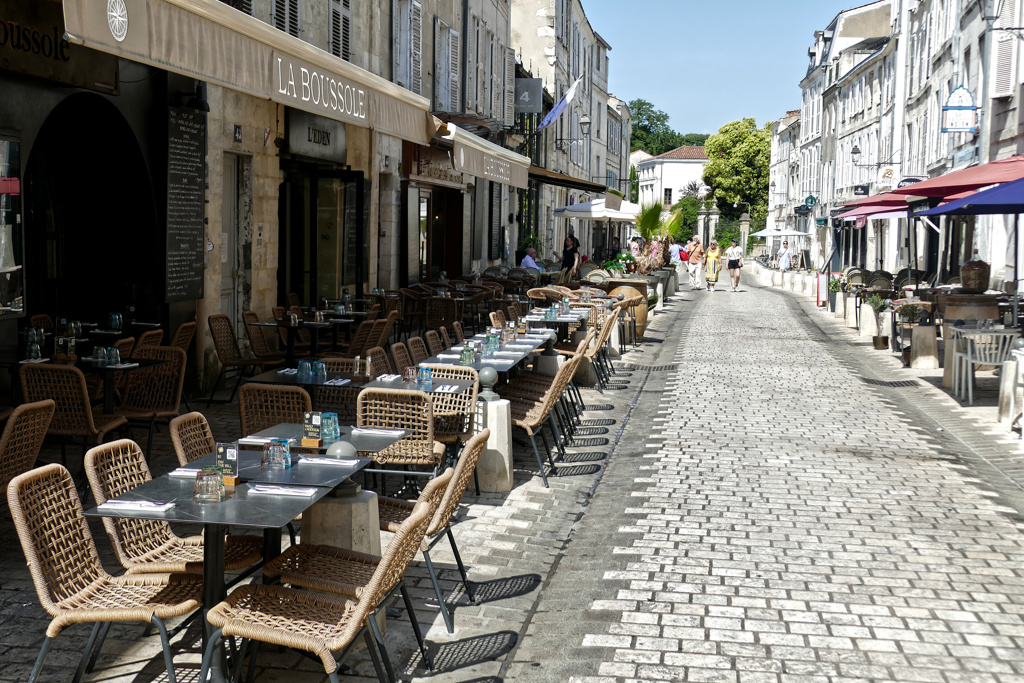
The Cours des Dames is characterized by its abundance of freshly caught fish, oysters, and the regional specialty, moules frites. Besides the Cours des Dames, the Rue Saint-Jean du Pérot is considered La Rochelle’s official gastronomic Cockaigne. While the Cours des Dames primarily boasts stunning views, the Rue Saint-Jean du Pérot convinces with its high concentration of top-notch, creative, and international restaurants. Here, gourmets will find a rich mix of refined French cuisine and innovative fusion dishes. An architectural highlight of the street is Les 4 Sergents, where fine dining is enjoyed beneath an impressive glass roof, originally designed in Gustave Eiffel’s workshops. Together, these two streets offer everything that defines the culinary experience of the French Atlantic coast, from casual waterfront bars to elegant gourmet menus in historic settings.
Cash, Cards, and Deals
Until now, 21 European countries replaced their former local currency with the €uro starting in 2002. Obviously, France is one of them. The exchange rate is 1 US$ = 0.84 EUR as of November 2026. However, you can check today’s conversion rate on this page. Credit cards and contactless payments are accepted almost everywhere.
There’s so much to see and do in La Rochelle. Fortunately, the La Rochelle Océan Pass* offers a much-appreciated opportunity to save some money. It’s a digital tourist card that combines numerous leisure activities, attractions, and transportation options into a single digital ticket.
A key feature of the pass is free use of public transportation. This includes not only city buses and sea buses within La Rochelle, but also regional trains and bus lines connecting the city to surrounding destinations. This means you can even reach places like Île de Ré without an additional ticket.
| Adult | Teen 12-17 years | Child 4-11 years | |
| 48 hours | 48 €uro | 28 €uro | 24 €uro |
| 72 hours | 62 €uro | 35 €uro | 31 €uro |
| 7 days | 82 €uro | 46 €uro | 42 €uro |
| 72 hours Winter Pass* | 35 €uro | 22 €uro | 12 €uro |
* The so-called Winter Pass is only available during the low season from November to January.
Connection and Communication
Since June 2017, no roaming charges have been applied within the EU with a European mobile phone contract. This applies in all 27 countries of the European Union as well as in Iceland, Liechtenstein, and Norway, and to all contracts.
In case European roaming is unavailable, you can connect to the internet without any issue at basically every museum, eatery, café, and, of course, hotel.
If you insist on being online 24/7, you can get a SIM card, obviously. There are prepaid SIM cards from many companies. At 2.99 €uros, Orange France distributes the cheapest one. Other brands are SFR France, Bouygues Telecom, and Free Mobile. They cost 10 €uros. Keep in mind that some companies might also charge an activation fee.
In France, they use plug types C and E. Their voltage is 230 V and the frequency 50 Hz. Whereby, as nowadays, all these chargers have integrated adapters, in general, the voltage and frequency don’t really matter.
By the way, you’ll find this information and many more comprehensive travel tips in my post World’s Most Complete Travel Information – an indispensable globetrotter classic.
Language
The French are famous for many great things. Presumably, speaking foreign languages isn’t one of them. Despite being quite a touristy place, it mainly caters to French visitors. And while many French people still understand at least more or less what you are saying, they might not be able or willing to answer in English. Therefore, already out of respect, it won’t hurt to learn at least some polite phrases with the help of Babbel or Lingohut, for example.
Map
This map should help you find all the wonderful places I’m introducing in this post. This way, you can plan your itinerary accordingly. Clicking on the slider symbol at the top left or the full-screen icon at the top right will display the whole map, including the legend.
Pinnable Pictures
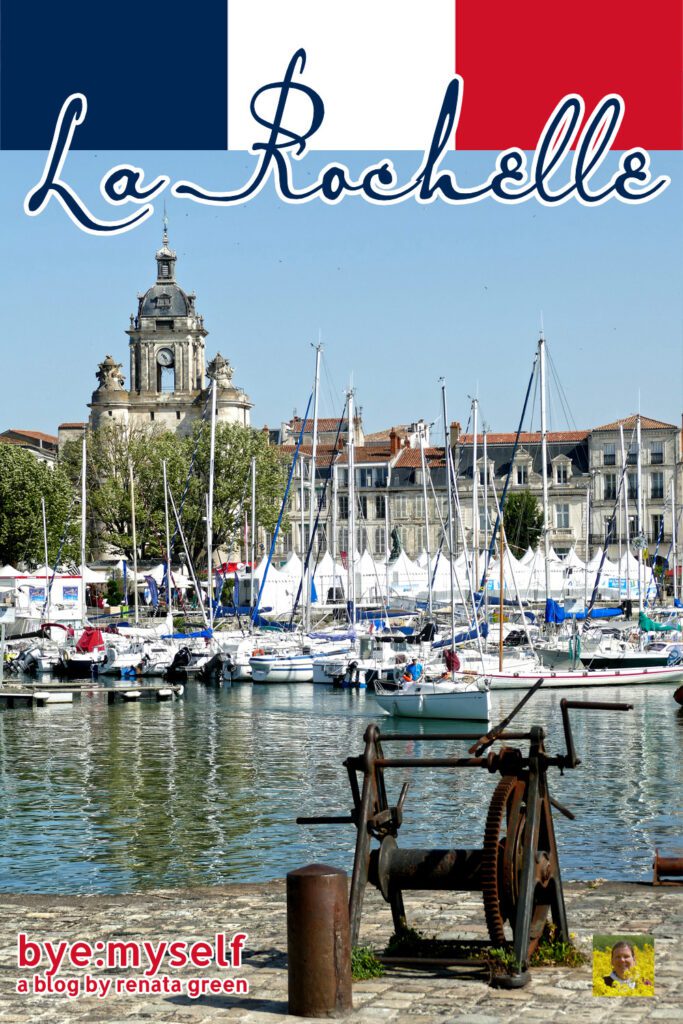
If you choose to pin this post for later, please use one of these pictures:
Did You Enjoy This Post? Then You Might Also Like These:

What Not to Miss in Saint-Martin, the French Half of the Friendly Island

GUADELOUPE: Complete Guide And Perfect Itineraries (also for travels by public bus)

The Best Street Art in MARTINIQUE
24 hours in BORDEAUX

The Best Beaches in Guadeloupe You Can Easily Visit by Public Bus

Perfect Guide For a Day Trip to SAINT-EMILION

Best Street Art in PARIS: How Mehdi Ben Cheikh Transformed the 13th Arrondissement Into An Open-Air Gallery

Best Places to Visit in Grand Terre, the Eastern Wing of GUADELOUPE (also by public bus)
*Obviously, this is an affiliate link. If you book through this page, you not only get the best deal. I also get a small commission that helps me run this blog. Thank you so much for supporting me!